Monday, November 1, 2010

From the desk of “Quark” – a bit of financial strangeness

Vectors

Predictive Modeling companies attempt to create projections for the future based on various economic scenarios. There are quite a few companies producing these vectors and they have a wide variety of uses for financial institutions.

Inputs to vectors.

Some of the standard inputs for producing vectors are:
*Home Price projections
*Unemployment projections
*Forward Interest Rates
*Property Valuations
*Borrower Credit Profiles
*Loan Characteristics and related historical data

Uncertainty Principles and Quantum Effects

Questions from various market participants arise as to how “granular” should these items be. For example, should we create projections only at the national level or drill down to state or county, even zip code projections? Similarly, with unemployment projections, should we do this at the state or county level or are national level statistics sufficient? Arguments for and against each point of view exist. One view is that doing it at too granular a level gives way too many inputs to take in, and by focusing so intently on the “micro” level, you’re losing sight of the forest. Another opinion is that too much of a macro view gives one not enough insight into what’s happening at the detail level, and you’re losing touch with reality.
Another way to think of this is with a “quantum world” view – where when you attempt to determine the exact position of a particle, you cannot determine its exact speed. If you determine the exact speed, you cannot find its exact position. By drilling down to zip code + 4 unemployment data – you might lose sight of more macro trends that would impact that area. Yet, by focusing on, say, too wide a range of home price indices, to use another example, you tend not to see the actuality of what’s happening with properties relevant to specific RMBS of interest. It’s perhaps a bit of a stretch to apply this to the same quantum effects, but maybe not. Certainly the question arises as to how much granularity is sufficient. When do you need more detail and when do you not?
One vendor I spoke with recently has even gone so far as to produce the property address of homes backing RMBS, but apparently you can only actually SEE the property address for yourself, if you sign a document stating that you will not then go looking at the borrower credit profile (such as from Equifax, Experian, or TransUnion). Because RMBS loans are “anonymous” (aka “de-identified) in the sense that you don’t know who the borrower is, nor do you know the property address, then solving the problem of “where is the property located exactly so that the most granular level of property valuation can be performed” can be highly valuable indeed. Here again, though, we have this almost “quantum” oddity of “being able to determine the exact location of a property, but not then being able to determine the credit profile of the borrower who owns the property.
Of course, if a property is now REO, then the current owner of the loan IS the owner of the property and no credit profile is needed particularly. In the case of RMBS, the Trust itself has become the “owner” of the property. With foreclosures and REO at such high percentages of deals, then the need lessens for credit profiles of the original borrowers of these particular loans, as these original borrowers have been evicted and no longer have any rights to the property itself.
Surely, I’m just imagining this “quantum effect.” It can’t possibly apply to finance… Enough with all this uncertainty!
So what is the way forward here? We maintain that thinking things through in the above manner leaves one without any really defensible viewpoints. How about we go forward and use a “results-driven” approach? In this approach we try a wide variety of approaches – trying each one of them under a wide-variety of levels of granularity. Don’t stick too much on any one approach, but then save these predictions for ALL of these variations. Then each month look at the actualities of what occurred in the real world and see which approaches most closely approximated what was found in the real world. Do this month after month and don’t develop any particular prejudices. In other words, constantly be on the alert as to which approaches produce the most practical real-world results. Perhaps then, a pattern may emerge as to which “solution” fits best.
Hopefully, then, we won’t have a situation where the “solution” itself only “resolves itself” when we observe it closely; but maybe the next time we observe it, it’ll be a different answer – just like, quantumly speaking, when a particle is observed, it’s location cannot be determined.
One thing is for sure, you want your predictive modeling company to be able to show you what their predictions were at various points in time (without the benefit of 20-20 hindsight) and have them show you how did their predictions do. Any predictive modeling company worth their salt for their crystal ball techniques should be able to show you how their predictions performed. We’re not saying they should be 100% perfect in all their predictions under all circumstances, but they should be able to show you exactly how they did – unless of course, they’re embarrassed to show you how badly they did.
In any case, if you want to get information on “the exact property address and home valuation”, check out a vendor which provides a very interesting solution as regards to home property valuations matched against the anonymous loan-level securitized data. See Lewtan’s ABSNet Home Val ™ solution here:
http://www.lewtan.com/products/ABSNEThomeval.html

Have a nice day. See you next observation – maybe.
Quark Out!

Friday, October 15, 2010

Securitization For The Rest Of Us!

Thetica Systems is happy to announce the fall release of our eBook: Securitization For The Rest of Us! Readers will discover the basic building blocks required to turn debts into income, and to utilize the power of numbers to create a flow of billions of dollars with the creation of bonds that profit the adventurous few with the capital to invest. Our eBook also examines the factors that directly resulted in the Wall Street losses at the end of this decade, from which our economy is still recovering. Enjoy this introduction…it starts us out on a journey that will have some hills to climb, but at its end, you will have a much wider viewpoint to understand our economy. This is Securitization For The Rest Of Us!

Introduction – Securitization For The Rest Of Us!

Wednesday, October 6, 2010

More Pictures from the ABS East 2010 Conference

This is a shot from outside the Fontainbleu Hotel in South Beach, Miami, where the ABS East Conference was held.


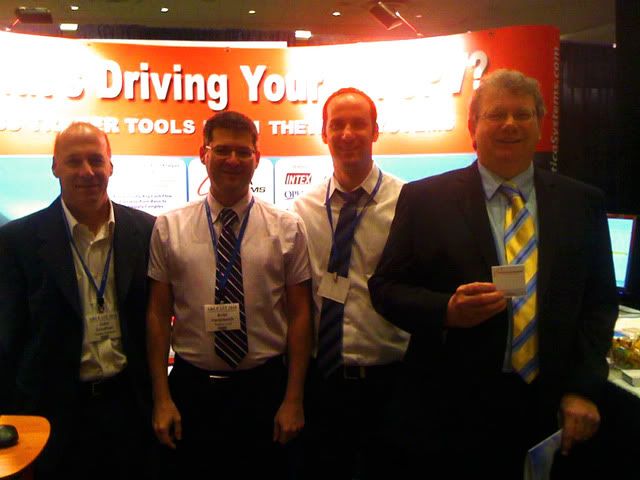
Here are a few members of Thetica Systems, including CEO, Ariel Yankilevich(mid) and President, Jack Broad(right), on day three of the ABS East Conference at our exhibitors display booth.


And here is another shot with a couple of friends (notice Jack holding our custom stucky note pad).


Last night, Tuesday, Oct. 5th, we packed up everything and called it a day. And today we head back to base to regroup.


Tuesday, October 5, 2010

The ABS East Conference 2010

Here are a few pictures of the extravagant Fontainbleu Hotel in South Beach, Miami, where the ABS East Conference is currently taking place and where Thetica Systems has set up shop as an exhibitor.

Fontainbleu Hotel

Photobucket

This is our CEO, Ariel Yankilevich, at our exhibitors display at the ABS East Conference;

Photobucket

And here is Ariel again giving a demo in our prospective client flooded exhibition area.

Thursday, September 30, 2010

Data Commoditization in the Securitization Markets (Part 3)

Today we proceed with the third installment and continuing discussion of the RMBS data industry with a section on “Loan Data Vendors”.


2. Loan Data Vendors – these are data vendors who specialize in the collateral (loan) information. This seems to overlap with component #1 item C (in blog entry 2 of this series), and to some degree it DOES overlap, however, Intex has not been known for providing the level of loan detail and in particular, ongoing historical monthly payment information that a proper Loan Data Vendor provides. Intex does provide monthly collateral information but it can be quite difficult to see and/or analyze it from an historical perspective. This thereby creates a market “niche” that various companies have stepped into in order to capture this need. Examples include Loan Performance (this is the largest and most well-known of the loan data vendors) , Black Box, ABSNet (Lewtan), Lender Processing Services, S&P and others. Most importantly this component includes at least the following:

a. Loan Data: this includes many fields of information relating to the actual loan itself including such things as original balance, current balance, purchase price of the property, zip code, state, MSA (Metropolitan Statistical Area), loan purpose (purchase, refinance or cash out), occupancy status (primary residence, investment property); documentation of income or assets, sale price, loan to value ratio, first or second lien, interest rate, loan type (fixed rate or adjustable rate mortgage), if an ARM loan, then what index does the loan reference, Interest Only period (if any), any prepayment penalties and for how long, loan modification details and so forth.

There are over 20 million loans within non-agency securitized deals so you can see that this is a fairly large data set.

b. Historical monthly payment records. These records tell you each month whether the borrow has paid and if so, how much; if the borrower is delinquent and how many days (30, 60, 90+); whether the loan is in foreclosure proceedings and, if it has already been foreclosed, how long it has been in REO. Also, when the property has been liquidated and whether there have been any losses and so forth.

Some loan data vendors provide web-based tools that you can use to query their loan data but many firms also license to routinely receive the data from the loan data vendor onto their own computer systems because they have mortgage research groups who want to be able to analyze the data in depth in order to assist them to predict the future performance of the loans based on what the historical data shows. This provides only a partial picture of the borrower and the property serving as collateral. See the next section for an extremely important additional piece of the puzzle.

**Watch for our next post describing “Enhanced Loan Data Vendors”.

Data Commoditization in the Securitization Markets (Part 2)

Today we continue our discussion of the RMBS data industry with a brief section on “Deal Data Vendors”.

1. Deal Information Data Vendors – by this we mean those data vendors that provide information about deals which includes:

*Overall deal information (Deal name, issuer, investment banker, servicer, trustee, whether the deal is Prime, AltA, Subprime, Original and Current Deal Balance, Cleanup-Call details, etc)
*Tranches (cusips, tranche names, original and current balances, coupon information, writedowns, ratings, credit support, etc)
*Collateral data (loan-level details, loan originator, collateral group related information and historical payments, etc)
*Triggers (primarily cumulative loss and delinquency triggers)
*Hedge Information (interest rate swaps, monoline bond guarantees, etc)
*Historical performance (especially useful for deal surveillance purposes)
*and so forth

A notable example of a data vendor who has all of the above is Intex. This is the most familiar and most widely used vendor of deal information in the industry. There are others including ABSNet (Lewtan) and Markit that also provide this information, but none to the degree that Intex does. Intex has been the longest and most firmly entrenched player in this space and consequently, the most costly.

Whereas it’s true that Intex provides deal information inside deal files and that these files are routinely delivered to a properly licensed client’s own file server, these files are made up of “one deal per file” therefore it becomes quite difficult to compare deals or query across all subprime deals and so forth.

What is really necessary is for a client to have software that reads all of the data about the deals (as enumerated above) into a proper database which can then be queried and analyzed with the purposes of spotting trade ideas or opportunities or generating various reports.

Note that this component does NOT include Bond Analytics – see the 5th component for more data about Analytics Providers)

**Watch for our next post describing “loan data vendors”, coming soon.


www.TheticaSystems.com

Thursday, August 5, 2010

Data Commoditization in the Securitization Markets (Part 1)


July 7th, 2010

Written by Jack S. Broad

© 2010 Thetica Systems, LLC

Introduction

As has occurred within many industries throughout history, the data vendors that provide various information about securitization have been undergoing huge changes causing large price decreases and company consolidation. Additionally, we are seeing many new partnerships springing up concurrent with the increasing need for coherent complete systems to manage all information relating to securitized deals. Without a complete picture of your ABS bonds, how can you accurately assess risks and price volatility?

In this article, we will be reviewing what the key components of a securitization system should be and take a look at some of the vendors participating in each of those components and then describe some of the market forces which we think are creating more and more of a “commoditization” of securitization information.

This trend, we believe, is leading to substantial price compression for securitization data products, causing data to become cheaper and more accessible. This trend is continuing into the future and will result in better deals for industry participants.

In this paper, we describe all the major components of an RMBS information system so as to provide a broad overview of the data industry and how it relates to trading activities. We then go on to talk about some new initiatives in the industry and what their potential impacts will be on the various players in the market place and what this means for your firm.


Data Components of an ABS System

There are five primary components making up the key data needs relating to securitizations. Without these, a firm engaged in trading bonds backed by mortgages is going to be “picked off” by other firms and might as well not be trading as it’ll be just too risky.

These five components are:

  1. Deal Information Data
  2. Loan Data
  3. Enhanced Loan Data
  4. Predictive Model
  5. Bond Analytics

Historically, trading firms have emphasized one or more of the above components, mostly due to lack of investment in technology and data. It is no longer enough to be “two guys and a Bloomberg” in this industry. What is needed are comprehensive yet flexible systems.

*Our next blog posts will describe these components in some detail *